In this groundbreaking work Ladislaus von Bortkewitsch shows that rare events are Poisson-distributed.
http://www.archive.org/stream/dasgesetzderklei00bortrich#page/n5/mode/2up
Monday, June 29, 2009

Thursday, June 25, 2009
The Science of Better
Damn, it was Operations Research what we were looking for all the time.
Sunday, June 7, 2009
About the power of innovation
Advocates of innovation describe it as necessary tool in a recession to regain prosperity.
Shed no doubt on it, but this is a macro-economics truth. For a company it does not make sense at all: the innovation bears a risk and we know from the market equilibrium theory that the risk surcharge is such that the utility equals non-risk investments.
A good theory but do I know my risks? Donald Rumsfeld once made an epistemological speech about unknown unknowns. The probability of innovation taking off, in the end is unknown. But theory behave as they would know, they just don't know that they don't know. So in the end its a Rumsfeld-ian "unknown unknown"?
As always, listen to Mr. Taleb carefully. He designates revenue from innovation in the fourth quadrant.
Friday, June 5, 2009
Flippant Juror
During lunch I exercised on the "Flippant Juror Problem"
- a jury of 3 jurors decides by majority
- two jurors are serious experts, they make a right decision with the probability p
- one is a jerk, he just flips a coin with probability for head q=1/2 to decide
Is this jury better than a single person who also makes a right decision with the probability p?
The solution is they are equal. Thats indeed counterintuitive! The jerk sabotages the jury.
Annotation: If they would all flip a coin with majority vote it would be also equal to one flip
This leads to a question related to the electoral process with majority vote in general.
Given N voters, how many "coinflippers" M it takes to reduce their probability for right decision to one decision, hmm try to solve that....
Monday, June 1, 2009
Architecture is about the 'Form follows Function' principle
Functionality should determine the Structure.
If hardware would be perfect, if CPUs would process instantly an infinite amount of input for an extremely complex algorithm. If connectivity would allow for instant access to an infinite amount of data. If our programs could be proven right, never crashed. If nobody could eavesdropping or tamper our system, if one programmer could change the system in every direction at no time... we would not need to think about an architecture. The internal structure of a system would be of no concern.
If hardware would be perfect, if CPUs would process instantly an infinite amount of input for an extremely complex algorithm. If connectivity would allow for instant access to an infinite amount of data. If our programs could be proven right, never crashed. If nobody could eavesdropping or tamper our system, if one programmer could change the system in every direction at no time... we would not need to think about an architecture. The internal structure of a system would be of no concern.
The limits of given technologies demand counter-measures to support functions, therefore we employ architectural patterns and tactics to circumvent undesired limitations.
Not all technology hurdles can be circumvent in this way, and some functionalities remain unimplementable. Thus a quantum computer would allow more functionality but demand new architectures.
In the next post I will outline the Quality Attribute approach, to design the architecture of a software system out of business functions, given technological constraints
In the next post I will outline the Quality Attribute approach, to design the architecture of a software system out of business functions, given technological constraints
Friday, May 22, 2009
Somebody becomes rich just by luck
Whenever one is concerned with rare events, events with small probability of occurrence, the Poisson distribution shows up in a natural way. - Falk, Hülser, Reiss
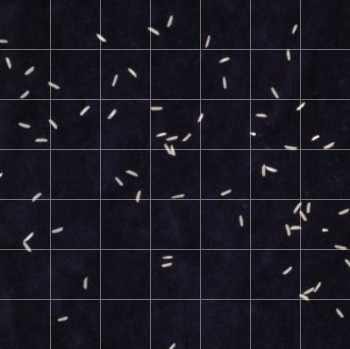
Lets spread some rice corns on a table, each cell represents a person.
Do we expect equal wealth for everyone, given that all have the same virtue and skill?
The Poisson distribution tells us 16 persons get nothing, the probability that you are one of them is 26%.
Over fifty percent get zero or one corn - means they are poor.
Thirtyfour percent are "two or tree corn" people, forming a middle class .
Over fifty percent get zero or one corn - means they are poor.
Thirtyfour percent are "two or tree corn" people, forming a middle class .
A person on the sunny side of life get four and two very lucky ones get even 5 corns, They are the rich five percent of society
| #corn | #people | P(X=corn) | |
| 0 | 16 | 26% | |
| 1 | 14 | 35% | |
| 2 | 10 | 23% | |
| 3 | 6 | 11% | |
| 4 | 1 | 4% | |
| 5 | 2 | 1% | upper-crust |
Random distribution of wealth leads to substancial inequality. Some people just make it, while most struggle. Is this the secret formula of "the american dream"?
Sunday, May 17, 2009
Representativeness Heuristic
Finally I concede myself to start with "Judgment under uncertainty: heuristics and biases" even though not finished with the development part of the Bayesian Network book.
The introductory chapter starts promising: the first cognitive antipattern (bias) discussed
The introductory chapter starts promising: the first cognitive antipattern (bias) discussed
Representativeness
When people are asked to judge if:
A belongs to class B
A originates from B
A follows from B
they use representativeness, or similiarity ommiting factors that should influence our judgement
They compare the description with the stereotype of e.g. a librarian.
Now have a look at the first fallacy with that: we ommit prior probability of outcomes, in fact we should consider that there are many more farmers than librarians before using the stereotype approach.
We fail to take into account prior probability, especially when given worthless evidence, neither wrong nor suggestive but simply worthless. With prior knowledge of a population of two laywers per engineer and the description
Prior probabilities play an important role in Bayesian Networks, thus fixing our biased judgement.
When people are asked to judge if:
A belongs to class B
A originates from B
A follows from B
they use representativeness, or similiarity ommiting factors that should influence our judgement
Steve is very shy and withdrawn, helpful, but with little interest in people. He has a need for order and passion for detail.How do people asess if Steve is engaged in a particular occupation (for example farmer, salesman, librarian, physician)?
They compare the description with the stereotype of e.g. a librarian.
Now have a look at the first fallacy with that: we ommit prior probability of outcomes, in fact we should consider that there are many more farmers than librarians before using the stereotype approach.
We fail to take into account prior probability, especially when given worthless evidence, neither wrong nor suggestive but simply worthless. With prior knowledge of a population of two laywers per engineer and the description
Dick is a 30 years old man. He is married with no children. A man of high ability and high motivation, he promises to be quite succesfull in his field. He is well liked by his colleagues.The experiment shows that overall, the sample judged the chance of Dick being an engineer is fifty fifty!
Prior probabilities play an important role in Bayesian Networks, thus fixing our biased judgement.
Subscribe to:
Posts (Atom)